

The Case for Active Solid-State Cooling in Smartphones, SSDs, and AI Glasses
Executive Summary
The AI compute revolution is creating a thermal crisis at the edge. Smartphones running on-device large language models throttle GPU clocks by up to 40% within 90 seconds. NVMe SSDs under sustained AI inference workloads lose 25% or more of their throughput. Smart glasses prototypes overheat past skin-comfort thresholds in under 30 minutes, breaking the promise of all-day wear and comfort.
These problems share a root cause: passive cooling—heat spreaders, vapor chambers, graphite sheets—has reached fundamental physical limits in compact, sealed form factors. Passive materials can spread heat, but they cannot generate the convective airflow needed to remove it.
This paper examines the thermal bottleneck facing three critical edge AI hardware markets, explains why passive solutions are insufficient, and introduces a new class of active cooling: solid-state MEMS micro-fans fabricated in silicon. We present third-party market data, published thermal benchmarks, and an engineering framework for evaluating active µCooling in next-generation designs.
The Thermal Problem: Why Edge AI Is Different
Edge AI hardware devices are caught in a vise. Processing demands are scaling exponentially—Apple’s Neural Engine grew from 0.6 TOPS in the A11 to 35 TOPS in the A17 Pro, a 58x increase in six years. Qualcomm’s mobile Hexagon NPU has followed a similar trajectory, scaling from 27 TOPS in the Snapdragon 8 Gen 1 to what Qualcomm describes as a 45% generational improvement with the Snapdragon 8 Elite, now capable of running on-device LLMs at 20 tokens per second.¹ But thermal budgets have not kept pace. Data centers dedicate kilowatts to active cooling—fans, liquid loops, facility HVAC. Edge devices, by contrast, have traditionally relied entirely on passive solutions that consume no power and generate no airflow, all within sealed enclosures that leave millimeters of space for thermal management.
The edge AI hardware market reflects this pressure. Precedence Research projects it will grow from $25.65 billion in 2025 to $143 billion by 2034 at a 21% CAGR.² Every device in that expanding market faces the same constraint: silicon gets faster, but physics hasn’t changed.
Smartphones
On-device AI workloads—LLM inference, computational photography, real-time translation—generate sustained thermal loads that passive solutions struggle to manage. Qualcomm’s own documentation notes that when a device’s back cover exceeds 45°C, the Snapdragon 8 Gen 2 drops GPU clocks from 680 MHz to 300 MHz and shifts to efficiency cores.³ XDA Developers reported up to 40% GPU clock reduction within 90 seconds of sustained AR workloads on modern Android flagships, and found that on-device LLM inference triggers CPU frequency throttling after only a few consecutive runs.⁴
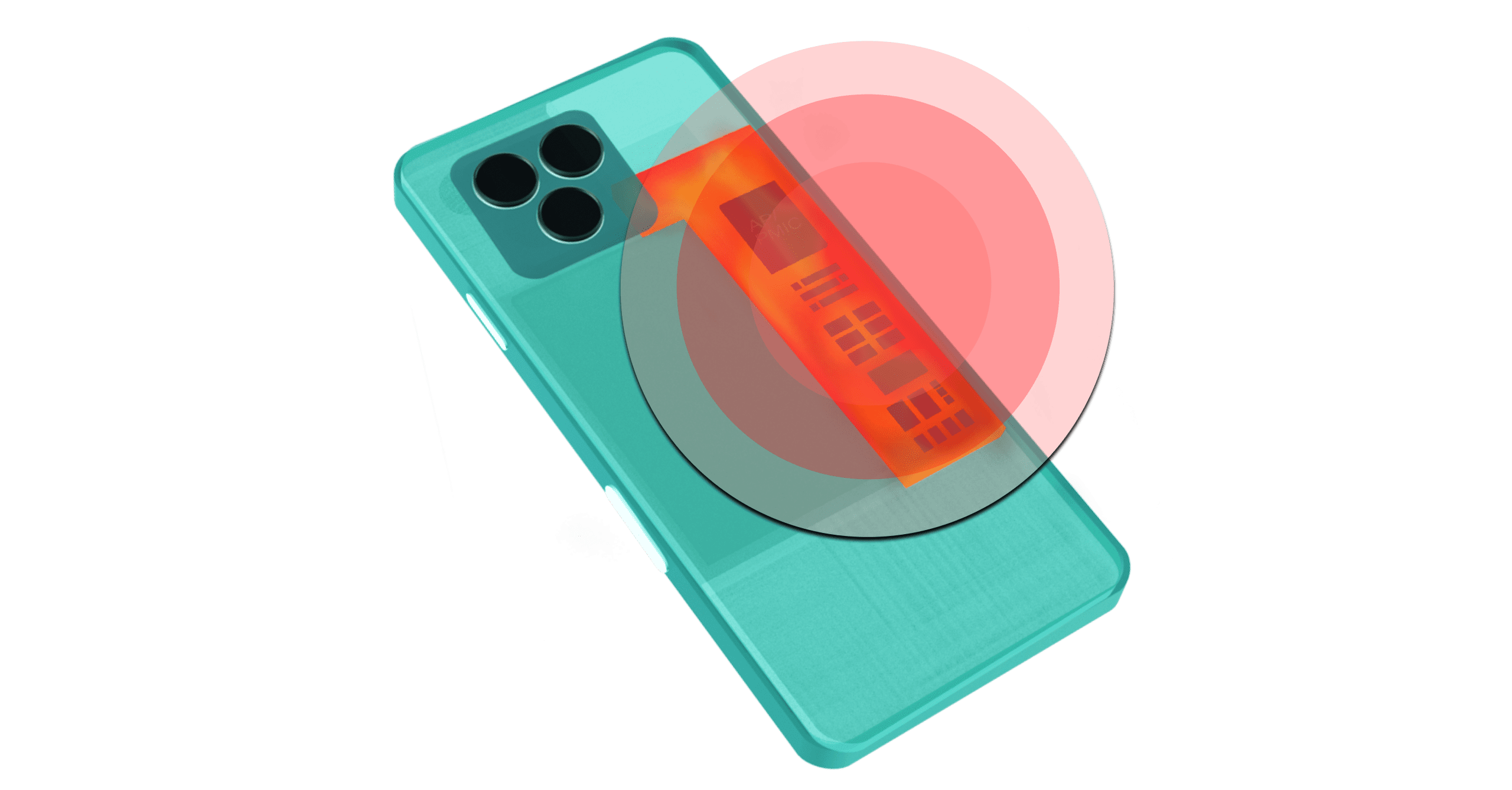
Figure 1: Thermal hotspot in a smartphone during AI processing workloads.
SSDs
NVMe SSDs in laptops, gaming handhelds, and ultrabooks throttle under the sustained read/write patterns generated by on-device AI workloads—large file exports from AI photo editors, local LLM model loading, and game asset streaming. Most SSD controllers initiate thermal throttling between 70–80°C. TechPowerUp’s testing of the Samsung 970 PRO documented a drop from 2.0 GB/s to 1.5 GB/s—a 25% performance reduction—once the controller reached 80°C.⁵ In thin, fanless devices where M.2 drives sit sandwiched against other heat-generating components, that threshold arrives faster than most consumers expect.
AI Glasses
Smart glasses are the most thermally constrained edge AI category. Meta’s Ray-Ban smart glasses originally shipped with a 1-minute video recording cap, later extended to 3 minutes via a software update—with How-To Geek noting that even 3-minute recordings drain the battery very quickly.⁶ Moor Insights & Strategy noted that Meta’s engineering emphasis was on achieving higher performance per watt without overdoing weight or thermals—an implicit acknowledgment that heat, not compute, is the binding constraint.⁷ As on-device AI capabilities expand into always-on assistants and real-time translation, the thermal ceiling will only tighten.
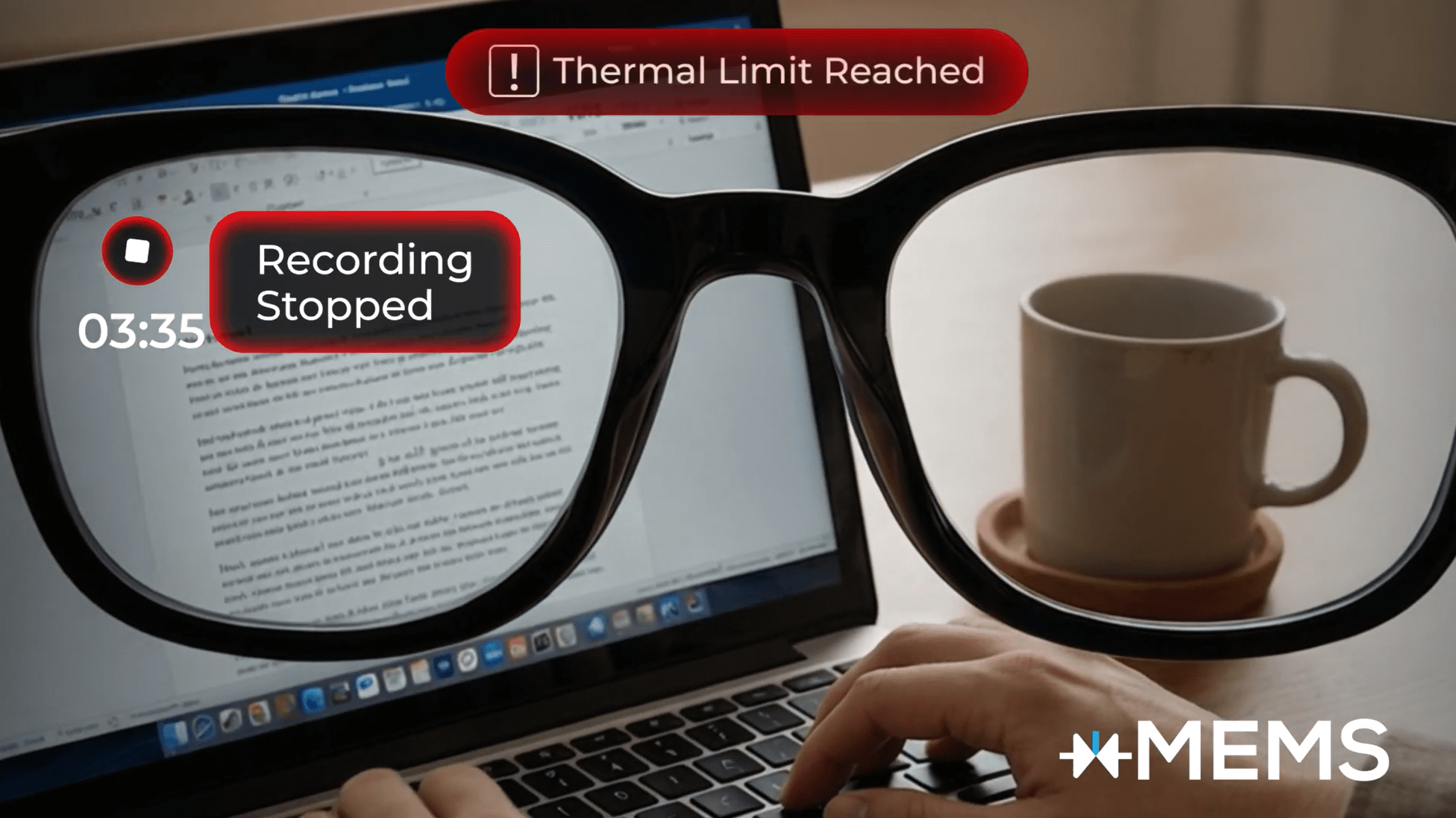
Figure 2: Video recording times are cut to manage overheating in AI glasses.
Why Passive Cooling Has Reached Its Limits
Every passive thermal solution—graphite sheets, vapor chambers, heat pipes, thermal pads—operates on the same principle: conduct heat away from the source and spread it over a larger surface area. None can generate airflow.
In sealed or low-airflow environments, a stagnant thermal boundary layer forms at the heat-dissipating surface, limiting convective heat transfer. Passive solutions can efficiently conduct heat to the surface, but they cannot significantly increase the external heat transfer coefficient. As a result, overall thermal performance becomes convection-limited, and further improvements in passive conduction yield diminishing thermal benefit at increasing cost and complexity.
Passive Cooling Technologies: Capabilities and Constraints
| Technology | Thermal Conductivity | Can Generate Airflow? | Form Factor |
| Graphite Sheet | 1,500–1,800 W/m·K⁸ | No — spreads heat only | < 0.1 mm |
| Vapor Chamber | Up to 50,000 W/m·K⁹ | No — redistributes via phase change | 0.4–1.0 mm |
| Heat Pipe | Up to 100,000 W/m·K⁹ | No — axial transport only | 2–6 mm dia. |
| Copper Spreader | ~400 W/m·K | No — conduction only | 0.3–1.5 mm |
| µCooling (xMEMS) | N/A — active airflow | Yes — forced convection | < 1.1 mm |
The gap between required thermal dissipation and passive capability widens with every product generation. Bridging it requires a fundamentally different approach: active convective cooling that fits within the same millimeter-scale constraints.
Active µCooling: Solid-State MEMS Fans-on-a-Chip
µCooling is a solid-state micro-fan fabricated entirely in silicon using piezoMEMS technology. Applying voltage to a piezoelectric thin film causes controlled mechanical deformation at MEMS scale, displacing air and generating directed convective airflow—the one capability every passive solution lacks.
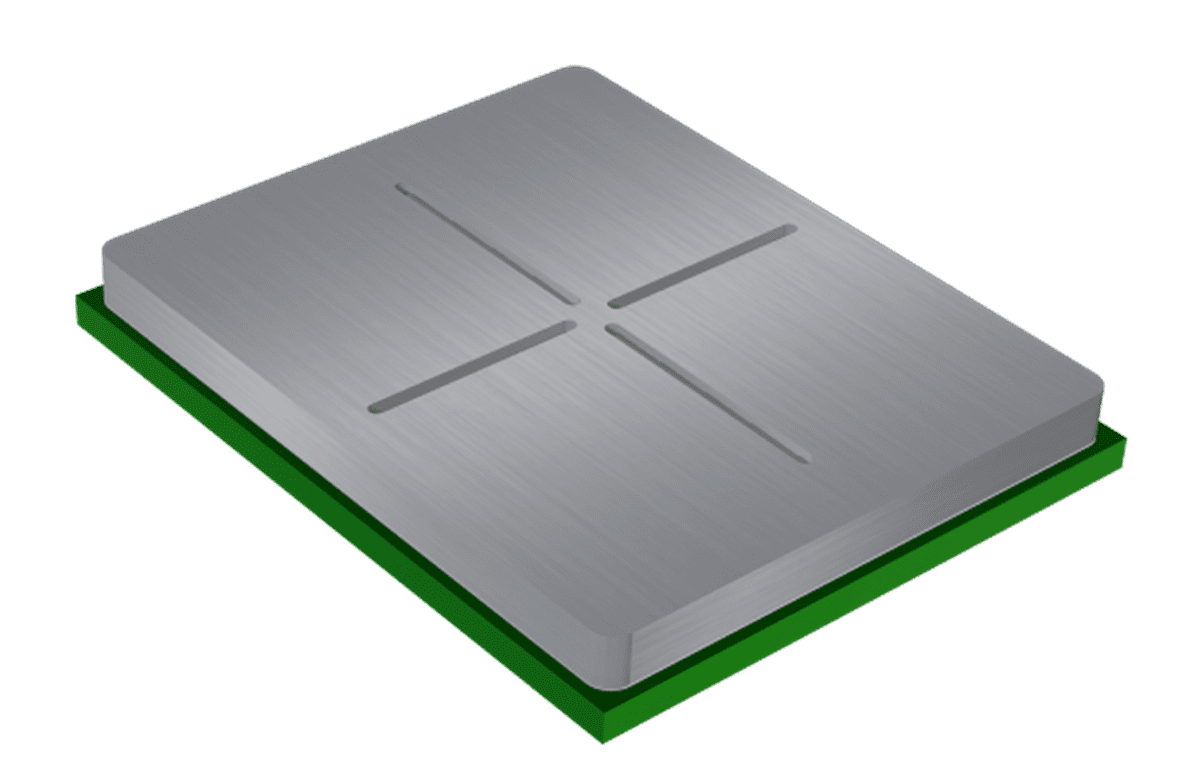
Figure 3: µCooling XMC-2400.
The device measures 9.26 x 7.6 x 1.08 mm, weighs under 150 milligrams, and consumes less than 200 milliwatts. It has no rotating parts, no bearings, and no mechanical wear mechanisms, with reliability on par with any other semiconductor device. It operates below the audible threshold—critical for devices worn on the head or held against the ear.¹⁰
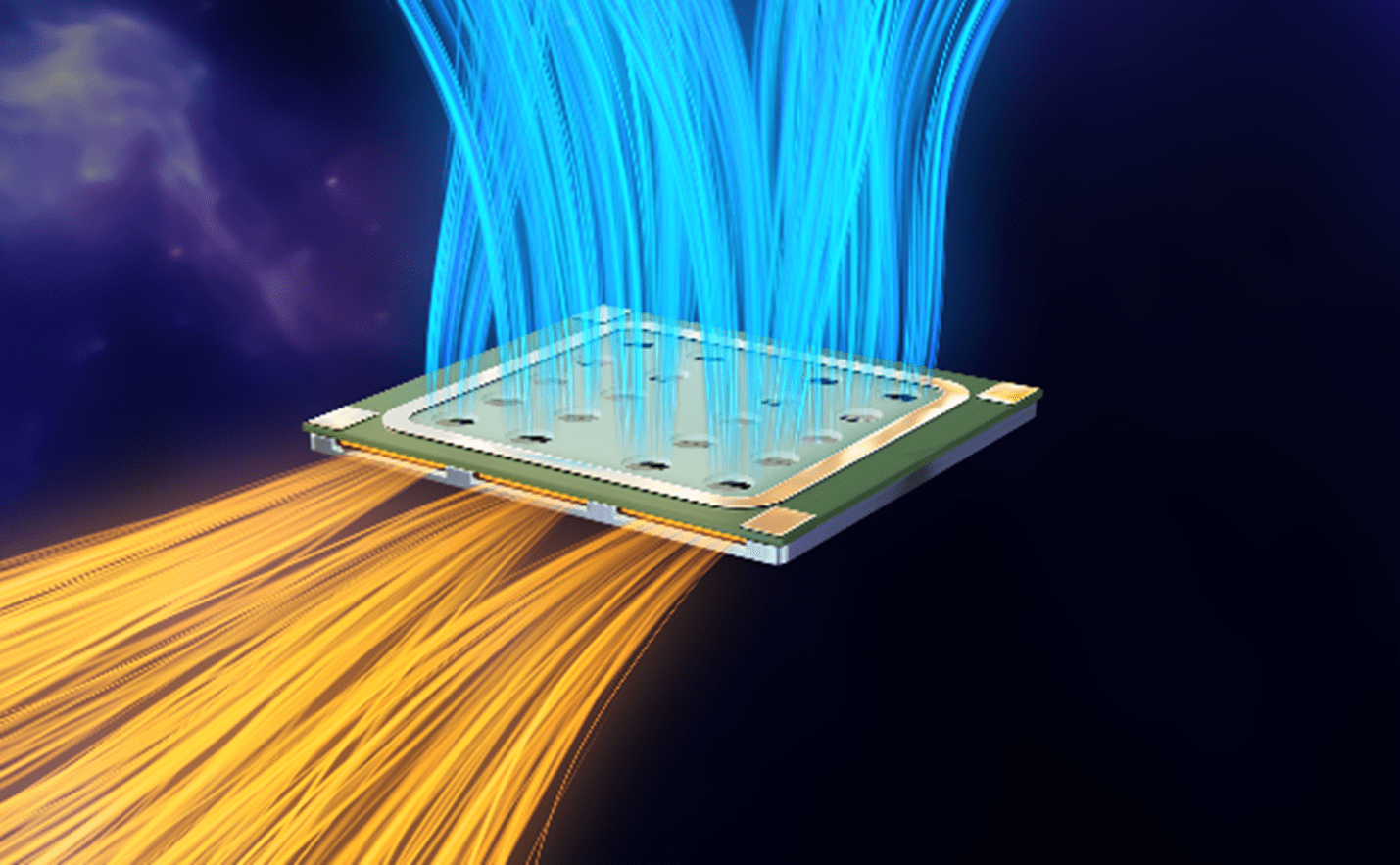
Figure 4: Airflow generated by the µCooling™ fan-on-a-chip.
µCooling does not replace passive thermal solutions. It augments them. Positioned between the heat source and the heat spreader, it breaks the stagnant boundary layer that passive materials cannot penetrate, creating the convective path needed to extract heat from a sealed enclosure.
When Active Cooling Makes Sense
Not every device needs active µCooling. Passive solutions remain sufficient for low-power, intermittent workloads in well-ventilated enclosures. Active cooling becomes necessary when designs meet two or more of these criteria:
- Sustained power dissipation above 1.5W in a sealed or near-sealed form factor
- Surface or skin-contact temperature must stay below 45°C under load
- Existing passive stack is already optimized (vapor chamber + graphite) with insufficient headroom
- Thermal throttling is degrading sustained performance by more than 10%


Conclusion
Passive cooling was engineered for a 5-watt world. Edge AI hardware devices now dissipate 3–15W of sustained thermal load in form factors that allow just millimeters of space for thermal management. The physics of conduction and radiation cannot close this gap. Only forced convection can.
µCooling introduces active airflow into the thermal stack at silicon scale—millimeter thin, silent, and fabricated with the same semiconductor processes that build the processors generating the heat. As the edge AI hadrware market scales from $26 billion to over $140 billion this decade, the devices that solve their thermal constraint first will define their categories. The rest will keep shipping 3-minute demos.
Watch the demonstration video µCooling: Enabling Next-Generation AI Glasses to learn more.
Sources
¹ SemiAnalysis, “Apple-TSMC: The Partnership That Built the Smartphone Era,” 2024. Qualcomm, Snapdragon 8 Gen 1 specifications (27 TOPS Hexagon NPU); Qualcomm, Snapdragon 8 Elite announcement, 2024 (45% NPU improvement over Gen 3). On-device LLM throughput: arXiv:2410.03613, “Understanding Large Language Models in Your Pockets,” October 2024.
² Precedence Research, “Edge AI Market Size, Share, and Trends 2025–2034,” 2025. Market valued at USD 25.65B (2025), projected USD 143.06B (2034), 21.04% CAGR.
³ XDA Developers, “The Silent Killer of Your Phone’s Performance: Thermal Throttling,” 2025. Snapdragon 8 Gen 2 behavior: GPU clocks drop from 680 MHz to 300 MHz when back cover exceeds 45°C.
⁴ XDA Developers, ibid. Reported 40% GPU clock reduction within 90 seconds of sustained AR use; on-device LLM inference triggers CPU throttling after few consecutive runs.
⁵ TechPowerUp, “Samsung 970 PRO 512 GB Review,” 2018. Sustained write performance dropped from 2.0 GB/s to 1.5 GB/s (25% reduction) at 80°C controller temperature.
⁶ How-To Geek, “Ray-Ban Meta Smart Glasses Are No Longer Limited to One-Minute Videos,” June 2024. V6.0 update extended recording from 1 minute to 3 minutes; noted that 3-minute recordings drain the battery very quickly.
⁷ Moor Insights & Strategy, “Ray-Ban Meta Smart Glasses Review: Better, Cooler, and More Useful Than Ever,” 2024.
⁸ HPMS Graphite, “Pyrolytic Graphite Sheet Specifications,” 2024. In-plane thermal conductivity up to 1,800 W/m·K.
⁹ Celsia Inc., “Vapor Chamber Cooling Design Guide” and “Heat Pipe Thermal Conductivity,” 2024. Effective conductivity range 4,000–100,000 W/m·K depending on length.
¹⁰ xMEMS Labs, “xMEMS Introduces 1mm-Thin Active Micro-Cooling Fan-on-a-Chip,” BusinessWire, August 2024. XMC-2400 specifications: 9.26 × 7.6 × 1.08 mm, <150 mg, CES Innovation Awards 2025 Honoree.