


By Joseph Jiang, CEO, xMEMS Labs
When people talk about the future of AI, the conversation almost always starts with processors. The headlines focus on larger models, faster inference, more parameters, and more powerful GPUs. The assumption is simple: better AI hardware will create better AI devices.
But after spending years working with device manufacturers across consumer electronics, wearables, and emerging AI platforms, I’ve come to a different conclusion. The future of Edge AI will not be determined by processors alone. It will be determined by the collection of hidden technologies surrounding them.
In fact, many of the most important innovations enabling the next generation of AI devices are components consumers will never notice. And that’s exactly what makes them so important.
The Processor Gets the Credit
Every successful technology era has a defining component. For smartphones, it was the application processor. For PCs, it was the CPU. For modern AI, it is increasingly the AI accelerator.
Those technologies deserve the attention they receive. Advances in computing continue to unlock extraordinary new capabilities. But processors don’t exist in isolation.
An AI device is an ecosystem of interconnected technologies. Cameras capture information. Sensors observe the environment. Wireless systems connect devices to networks and services. Audio systems enable natural interaction. Thermal systems help maintain performance and reliability.
A breakthrough in AI processing means little if the overall product cannot deliver a practical user experience. That’s becoming increasingly apparent as AI moves from the cloud into physical devices.
The Real Challenge Is Productization
Today’s Edge AI devices are expected to do something remarkable. They must continuously perceive, process, communicate, learn, and interact, often within products that consumers expect to be lightweight, compact, comfortable, and battery efficient.
Consider a modern AI wearable.
Inside a device no larger than a pair of glasses, engineers may need to integrate cameras, microphones, processors, batteries, wireless radios, displays, sensors, and audio systems.
Each subsystem competes for the same limited space. Each subsystem consumes power. Each subsystem generates heat. Adding intelligence is no longer the hardest part of the design challenge.
Successfully packaging that intelligence into a product people actually want to wear may be even harder.
The Hidden Battle Against Physics
One of the most interesting trends in Edge AI is that many of the industry’s greatest challenges are increasingly physical rather than computational. Heat has become one of the most significant constraints.
As processors become more powerful, their thermal demands grow. Excessive heat can reduce performance, impact reliability, affect sensor accuracy, and limit what a device can ultimately achieve.
At the same time, consumers continue to demand thinner, lighter, quieter, and more elegant products. The traditional approach has often been to make components larger to handle increasing performance requirements. That strategy becomes difficult when the product sits on someone’s face, fits in a pocket, operates inside a robot, or must function continuously throughout the day.
The future of Edge AI will require a different approach. Rather than simply adding more resources, designers must find ways to make every cubic millimeter work harder.
Invisible Technologies Create Visible Experiences
Consumers rarely ask what speaker technology is inside their headphones. They rarely think about thermal management systems inside a wearable device. Most users simply know whether a product feels comfortable, sounds good, performs reliably, and lasts throughout the day. That experience is determined by technologies operating behind the scenes.
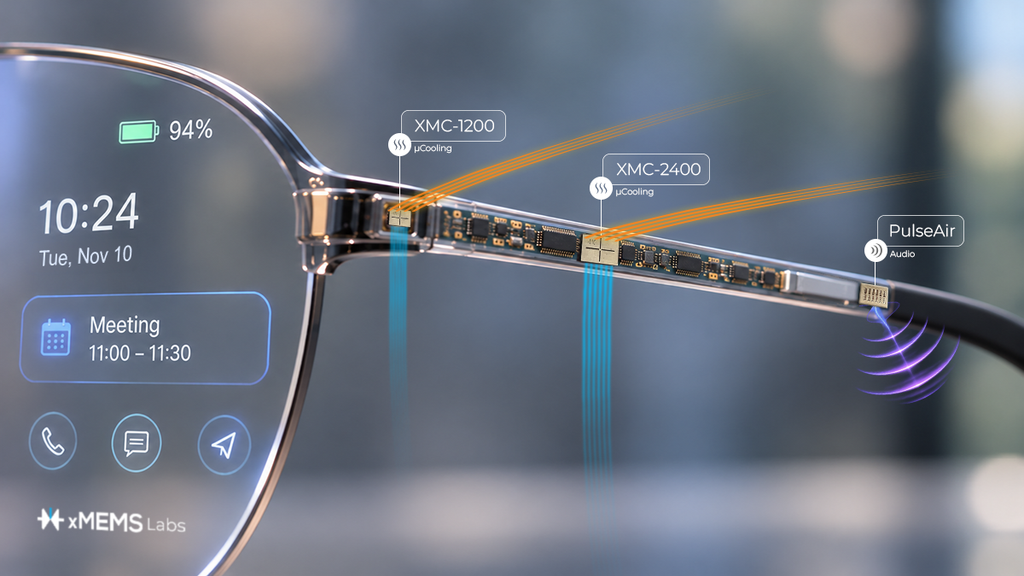
A lighter audio system may enable a more comfortable wearable. A more efficient thermal solution may allow a processor to sustain performance longer. A smaller component may free valuable space for a larger battery, additional sensors, or entirely new capabilities.
These decisions often determine whether a product feels revolutionary or compromised.
The reality is that many of tomorrow’s AI experiences will be enabled not by a single breakthrough technology, but by dozens of highly specialized innovations working together.
A New Era of System-Level Innovation
As Edge AI matures, I believe the industry will shift from a compute-centric mindset to a system-centric one. The most successful products won’t necessarily contain the largest models or the most powerful processors.
They will be the devices that best balance intelligence, power efficiency, thermal performance, sensing, connectivity, acoustics, comfort, and industrial design.
In other words, success will depend increasingly on integration. The companies that understand how all of these technologies interact will be best positioned to deliver the next generation of AI experiences.
That’s why I believe some of the most important innovations of the coming decade will be the ones consumers never see. They will be the hidden components that make intelligent products practical, wearable, reliable, and delightful to use.
See the Hidden Technologies at CES 2027
At CES 2027, xMEMS Labs will showcase technologies designed to help solve some of the fundamental challenges facing next-generation Edge AI devices.
From silicon-based audio innovations that enable new wearable experiences to solid-state micro-cooling technologies that address growing thermal constraints, we’re helping device manufacturers overcome the physical barriers that increasingly define AI product design.
If you’re developing AI wearables, smart glasses, robotics platforms, connected electronics, or other Edge AI systems, I invite you to visit the xMEMS Labs suite at CES.
The future of AI won’t be built by processors alone. Come see the hidden technologies helping make it possible.
Reserve a private meeting with the xMEMS team to experience the innovations shaping the next generation of Edge AI devices.
Want to see more content like this? Select xmems.com as a preferred source.