


As NPO and CPO bring optics closer to AI silicon, cooling the ASIC is no longer enough
By Kevin Hughes, Director of Business Development, Thermal Management BU, xMEMS Labs
Imagine widening every highway leading into a city while leaving the surrounding streets unchanged. More traffic reaches the city faster, but congestion simply moves to a different part of the system. That is increasingly how I think about AI infrastructure.
The industry is making enormous progress in optical connectivity. Near-packaged optics, or NPO, is emerging as a practical near-term path for bringing optical engines closer to high-performance silicon. Co-packaged optics, or CPO, takes that integration further and remains an important longer-term architecture.
Although the two approaches differ in packaging, integration, and serviceability, they are responding to the same fundamental challenge: electrical interconnects are struggling to keep pace with the bandwidth, power-efficiency, and density requirements of large AI systems. But solving the data-movement bottleneck exposes another constraint. Heat.
NPO First, CPO Over Time
At OCP, I heard substantially more attention being given to NPO as an actionable near-term architecture, while CPO was discussed more as a longer-term direction.
That makes sense. NPO shortens the electrical connection between the ASIC and optical engines while retaining more modularity than a fully co-packaged implementation. CPO brings the optical engines into much tighter integration with the switch ASIC, potentially delivering greater bandwidth density and energy efficiency, but with additional manufacturing, serviceability, reliability, and thermal-design challenges.
This is not necessarily an either-or transition.
Different architectures may serve different AI scale-up, scale-out, and networking requirements. Pluggable optics, XPO, NPO, and CPO may coexist as system designers balance bandwidth, power, cost, serviceability, and time to deployment.
For example, Astera Labs, described high-density silicon photonics NPO as a near-term deployment path, while placing resilient CPO further out on its optical roadmap. Its OCP demonstration included a cold-plate-cooled NPO switch tray and an external laser source form-factor pluggable.
The packaging architecture may change, but one important thermal requirement can remain: both NPO and CPO systems can use external laser sources.
External Does Not Mean Thermally Independent
Placing the laser outside the immediate ASIC package offers meaningful advantages. It can separate a temperature-sensitive and reliability-critical component from one of the hottest areas in the system. It can also improve serviceability because a laser source can potentially be replaced without replacing the optical engine or entire switch package.
But there is an important distinction: moving the laser away from the ASIC does not move thermal management out of the architecture. It creates a different thermal problem that must be solved deliberately. High-power laser sources still generate heat and their performance, efficiency, output stability, wavelength behavior, and operating lifetime remain connected to temperature.
As optical engines multiply and aggregate optical power rises, the external laser subsystem becomes more than a peripheral component. It becomes part of the system-level thermal design.
The cooling question is not limited to whether the laser is integrated or external but rather will the architecture maintain stable thermal conditions for every component required to deliver reliable optical performance?
Cooling the ASIC Is Necessary, but Not Sufficient
Modern AI switch silicon can require substantial cooling capacity. Direct liquid cooling and advanced cold plates will remain essential for handling these high-power devices. But a cold plate optimized for the ASIC does not automatically cool every optical and electronic component surrounding it.
In an NPO system, the optical engines may be mounted around the ASIC on the switch board. External laser sources may be positioned elsewhere in the tray or at the front panel. In a CPO system, the optical engines may be integrated much closer to the switch silicon while the laser source remains externally located.
Each location has a different thermal environment, airflow condition, heat path, and service requirement. This creates several distinct thermal zones:
- The primary ASIC zone, where liquid cooling may carry most of the thermal load.
- The optical-engine zone, where temperature-sensitive photonic components operate near high-power silicon.
- The external-laser zone, where heat must be removed while maintaining optical stability and serviceability.
- The supporting electronics zone, containing power conversion, control, and signal-management components.
A system can successfully hold the ASIC within its temperature specification while another thermally sensitive component operates with an inadequate margin. That is why processor temperature alone is no longer a complete measure of thermal success.
Cold Plates Do Not Eliminate Localized Hotspots
XPO and other advanced pluggable implementations may incorporate cold plates or connect to a liquid-cooling infrastructure. That is a logical response to rising module power.
However, extending liquid cooling to every heat source introduces trade-offs. Additional cold-plate interfaces, hoses, manifolds, seals, and service connections can increase mechanical complexity. They also consume space in systems where fiber routing, power delivery, airflow, and component access are already constrained.
Passive heat spreaders and thermal interface materials will continue to play an essential role. They can move heat away from concentrated sources and reduce local temperature gradients. But passive spreading does not make heat disappear. The heat must ultimately be rejected into air, a chassis, or a liquid-cooling loop. This is where future systems may need a more distributed thermal strategy.
Instead of treating the switch as one large cooling problem, designers will increasingly need to treat it as a collection of connected thermal zones. Each zone may require a different combination of liquid cooling, passive spreading, and localized active cooling.
The Future Is a Hybrid Thermal Architecture
There will not be one cooling technology that solves every NPO or CPO thermal challenge. Liquid cooling is well suited to the highest-power ASICs. Cold plates can also serve components that justify the plumbing, mechanical footprint, and service complexity. Passive solutions remain fundamental for spreading heat and coupling components into established thermal paths.
Localized active convection can complement these approaches by accelerating heat removal in areas that do not sit directly beneath a primary cold plate or where conventional airflow is insufficient.
The point is not to replace liquid cooling or passive thermal management. It is to address the gaps between them.
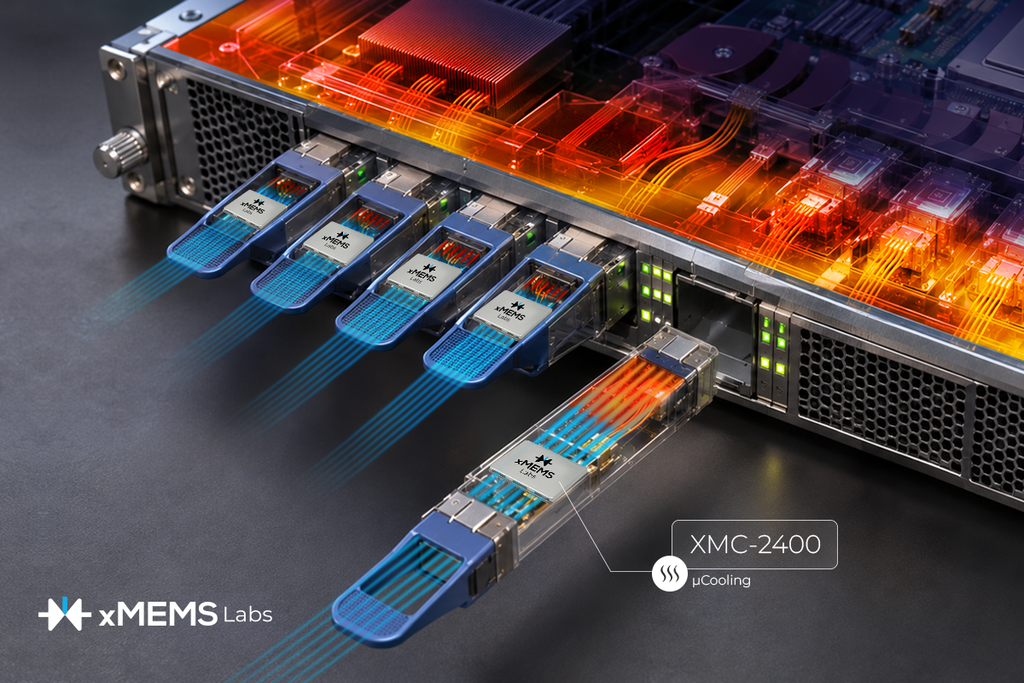
For external laser sources, an active convection solution could potentially improve heat transfer at the source, help reduce the temperature presented to a heat spreader or surrounding structure, and provide another design lever where adding liquid infrastructure is impractical.
The appropriate solution will depend on laser power, allowable operating temperature, available surface area, airflow impedance, form factor, redundancy requirements, acoustic limits, and the system’s broader cooling architecture. Since there is no universal answer that is why thermal planning must happen early.
Thermal Design Can No Longer Be a Downstream Decision
Optical architects often begin with bandwidth, reach, link budget, power, and serviceability. Thermal requirements can be treated as something to solve after the major architectural decisions have already been made. That sequence is becoming increasingly risky.
The choice between pluggable optics, XPO, NPO, and CPO affects component placement, thermal coupling, fiber routing, service access, and available cooling paths. The selection and location of an external laser source affect where heat is generated and how that heat can be removed. Thermal architecture is therefore becoming part of optical architecture.
For NPO, better thermal planning can help preserve its advantages in modularity and serviceability. For CPO, thermal design is even more deeply intertwined with packaging, photonic performance, and system reliability. Academic research has identified the combination of extreme ASIC power density and temperature-sensitive photonics as a critical challenge for CPO performance and reliability.
Waiting until the final stages of a platform design to solve these issues can lead to thermal compromises, mechanical redesigns, or unnecessary system complexity.
The Architecture Will Evolve, but the Thermal Requirement Will Not
NPO may be the nearer-term priority for many optical networking companies. CPO may become increasingly important as bandwidth density and energy efficiency requirements continue to rise.
External laser sources can play a role in both.
That gives the industry an opportunity to think about laser cooling as a shared architectural requirement rather than a problem specific to one packaging approach.
The next generation of optical networking will not be enabled by bandwidth improvements alone. It will depend on whether every critical component, from the switch ASIC to the optical engine and external laser source, can operate within a stable and reliable thermal environment.
The next AI networking bottleneck will not be how quickly we can move data but how effectively we remove the heat generated by the technologies that make that movement possible.
The need for localized thermal management extends well beyond optical networking. At CES 2027, xMEMS Labs will demonstrate how solid-state micro-cooling can address concentrated heat in space-constrained electronic systems. Contact us to schedule a meeting.
Want to see more content like this? Select xmems.com as a preferred source.