

XMC-1200, the industry’s solid-state µCooling chip enables targeted cooling for AR/XR light engines, processors, and other components in smart glasses
SANTA CLARA, Calif. — July 21, 2026 — xMEMS Labs, Inc., the inventor of solid-state cooling on a chip, today introduced the XMC-1200, the world’s smallest active micro fan. Engineered for AR, XR, and smart glasses, the XMC-1200 brings targeted, active cooling into slim, space-constrained form factors conventional fans cannot fit. By managing heat directly at the source, the µCooling chip helps glasses manufacturers enable brighter and more stable displays, sustained processor performance, longer video recording sessions, and improved wearer comfort.
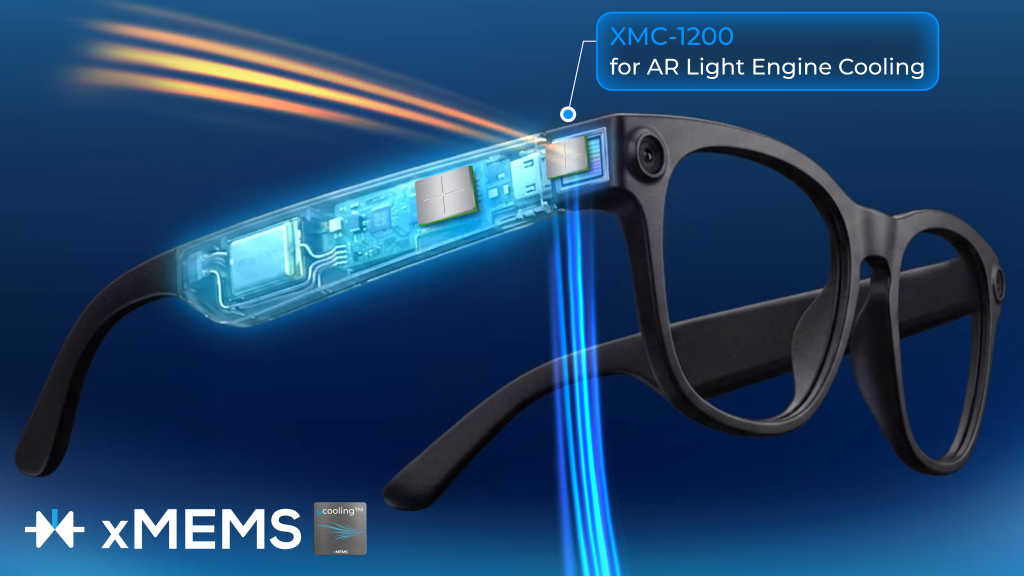
The XMC-1200 measures just 46mm², enabling integration into space constrained designs like glasses’ temple arms and other compact wearables. Paired with the Astra2 drive ASIC, the system consumes just 70 mW of typical power, minimizing impact on battery life, while delivering up to a 10°C temperature reduction at a 1W thermal load. This allows smart glasses and AR/XR devices to maintain sustained performance without overheating or throttling.
“We’re excited to see xMEMS Labs bringing breakthrough innovation to active cooling for AR and smart glasses. Thermal management has long been a key bottleneck, forcing OEMs to make trade-offs between performance, form factor, and user comfort,” said Peter Richardson, Vice President at Counterpoint Research. “As active cooling technology matures, we expect next-generation smart and AR glasses to deliver greater on-device AI performance in lightweight designs while maintaining user comfort through more effective heat dissipation. This will become increasingly important as more demanding AI applications emerge and truly standalone AR glasses, such as Snap’s SPECS, enter the market. We believe advances in active micro-cooling will help accelerate the adoption of smart glasses with see-through displays and on-device AI, enabling richer, always-on AI experiences.”

“Glasses are colliding with a thermal wall, and the industry has been engineering around the problem instead of through it,” said Mike Housholder, Vice President and General Manager of the Thermal Management Business Unit at xMEMS. “Devices are getting hotter, and a rotary fan simply will not fit inside a temple arm – mechanically, acoustically, or thermodynamically. The XMC-1200 is the first active cooling device thin enough, quiet enough, and efficient enough to work where glasses electronics live.”
The XMC-1200 arrives as thermal management becomes one of the defining design challenges for next-generation smart glasses. Light engines, camera systems, and the SoCs powering on-device AI, translation, assistant features, and high-resolution video are becoming more capable and more power dense. At the same time, glasses must remain thin, lightweight, quiet, cool, and comfortable enough for all-day wear.
That combination has forced manufacturers to make tradeoffs. Displays may be brightness-limited to preserve image stability. Processors may throttle after short periods of use. Camera-based glasses may restrict video recording time to prevent overheating. Heat may also accumulate near the wearer’s skin, creating comfort issues that limit mainstream adoption.
For AR and XR light engines, targeted cooling can help preserve visual performance over longer periods of use. As microdisplay LEDs and laser light sources heat up, their wavelengths can drift, contributing to color bleed, white-point shifts, and other image quality issues. By helping keep these light sources within their intended operating range, the XMC-1200 supports more consistent color accuracy, contrast, and brightness.
For smart glasses processors, active cooling helps sustain performance rather than forcing the device to quickly throttle. That is increasingly important as glasses move beyond simple notifications and audio playback toward real-time AI, voice assistants, translation, computer vision, and multimodal user experiences that require consistent compute performance within a small thermal envelope.
For camera-based eyewear, the XMC-1200 helps address one of the category’s most visible limitations: short recording windows. High-bandwidth image sensors and video processing engines generate heat inside compact enclosures with limited airflow and minimal space for traditional heatsinks. By actively managing heat at the source, the XMC-1200 can help extend recording sessions and enable users to capture longer events, conversations, and POV experiences.
User comfort is another critical application. The XMC-1200 can help move heat away from the temple arm before it reaches the wearer’s skin, reducing surface temperatures and improving comfort during extended use. Even modest temperature reductions can determine whether a device feels warm, distracting, or natural enough to keep wearing.
“This is the cooling chip the glasses industry has been waiting for,” Housholder added. “The XMC-2400 is in production today and is already supporting xMEMS’ first glasses deployments, while XMC-1200 engineering samples are now available to lead OEMs. Solid-state µCooling is now a commercial technology built to directly address one of the smart glasses’ industries more pressing challenges.”
XMC-1200 engineering samples are available now under NDA to qualified AR, XR, smart glasses, microdisplay, and wearable customers, with production readiness targeted for Q4 2027. The XMC-2400, optimized for higher-power glasses processors and the first xMEMS µCooling device in mass production, is shipping today and supporting xMEMS’ first glasses design wins.
For more information about xMEMS and XMC-1200, visit xmems.com/micro-cooling-xmc-1200. For hi-res imagery of XMC-1200, click here.
About xMEMS Labs
xMEMS Labs, Inc. is advancing the foundation of AI hardware by eliminating longstanding constraints in thermal and audio design. Its proprietary piezoMEMS platform enables a portfolio of thin and light solid-state speakers and µCooling solutions that deliver silent, reliable, chip-level performance for increasingly compact and powerful devices, including SSDs, smartphones, AI glasses, and AR/XR systems. Based in Santa Clara, California, xMEMS is enabling sustained performance in the next era of AI computing. Visit xmems.com.
Media Contacts
Marta Majstorovic
Griffin360
Pierre Golde
xMEMS Labs, Inc.