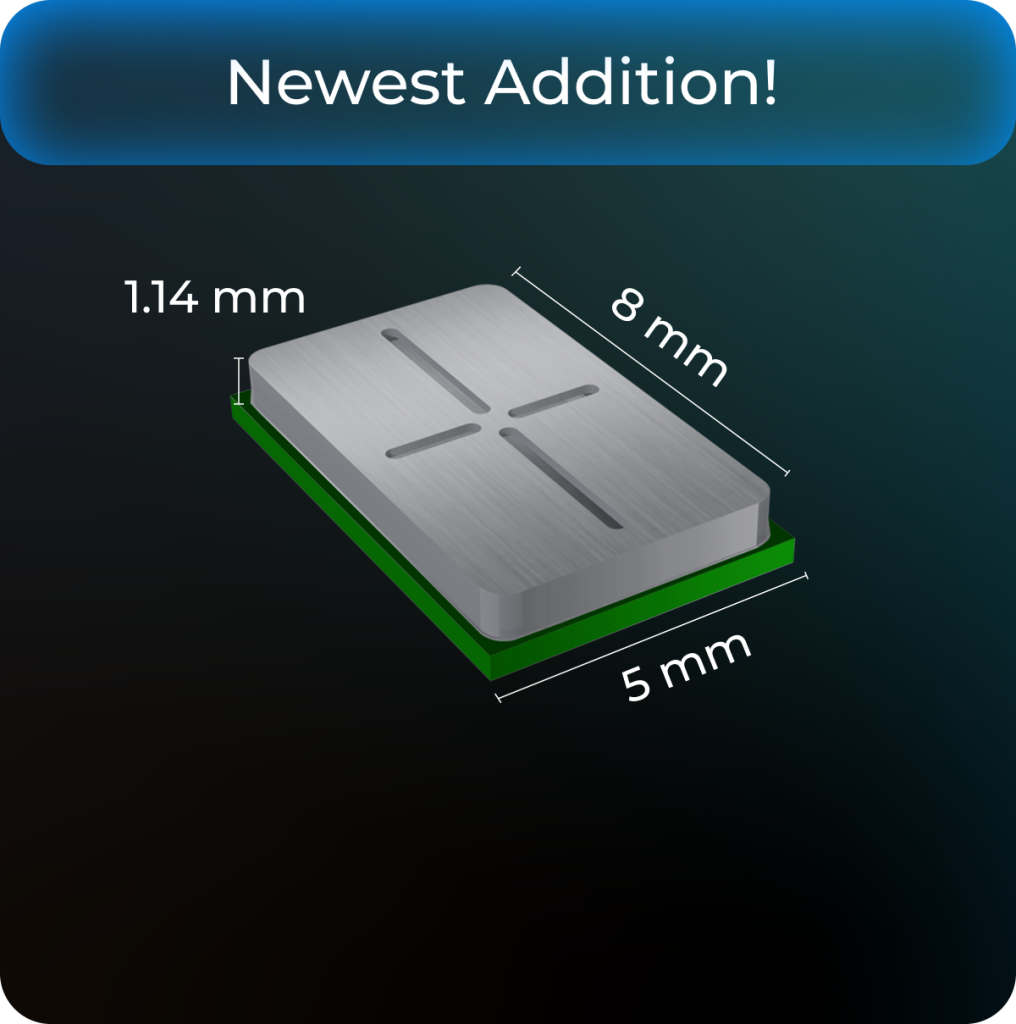
µCooling: The World’s First Active Convection Chip
All-silicon, solid-state active thermal management solution for Edge AI devices and low-power data center subsystems
1mm
Thin
150mW
Power
Up to 48cc/s
Airflow
IP68
Water and Dust
Silent,
Vibration-free
From Pocket to Rack
µCooling™ delivers hyper-local, targeted airflow exactly where heat is generated, directly at the processor and other critical components, to manage heat.
µCooling fan-on-a-chip delivers targeted, silent cooling right where it’s needed, reducing temperatures by 10–20°C in spaces where liquid cooling can’t reach.
OSFP Transceiver
First in-module active cooling small enough to embed inside 400G, 800G, and 1.6T optical transceivers.
E3.S SSD
Delivers hyper-localized active cooling directly to NAND flash and controller ICs from within the SSD itself.
DDR5 DRAM
Addresses hotspots in space-constrained edge deployments where liquid cooling is impractical.
Active Cooling using PCB µChannels
See how µCooling lowers the PCB’s steady-state temperature to 64°C, compared to 77°C without it.
Thin-film piezoelectric material deposited on silicon expands and contracts at ultrasonic frequencies, converting electrical energy into mechanical motion.
02 Air Pulse Generation
Membranes vibrate above human hearing range, creating continuous high-velocity air pulses through precision micro-valve arrays on the chip.
03 Directed Airflow
Top-venting or side-venting packages direct cool air onto heat sources, or through isolated channels thermally coupled to target components.
04 Heat Dissipation
Localized forced convection dissipates heat from hotspots, sustaining component performance and extending hardware lifespan.
Frequently Asked Questions (FAQs)
What is µCooling™?
µCooling™ is an all-silicon, solid-state active cooling technology that delivers targeted airflow directly where heat is generated. Unlike traditional passive cooling solutions that only spread heat, µCooling actively moves air to help remove heat from processors and other critical components. The technology is built on xMEMS’ piezoMEMS platform and is designed for space-constrained devices such as AI glasses, smartphones, tablets, SSDs, and other Edge AI systems that can’t accommodate conventional fans.
How is µCooling different from a traditional fan?
Traditional fans rely on rotating blades and mechanical assemblies that consume space, generate noise, and can wear over time. µCooling uses microscopic silicon membranes vibrating at ultrasonic frequencies to create airflow without spinning blades. The result is a compact, solid-state cooling solution that is silent, vibration-free, and thin enough to fit inside devices where conventional fans cannot. µCooling supports automated pick-and-place assembly and surface mounting to rigid or flex PCBs for high-volume manufacturing.
Why do AI devices need active cooling?
AI applications such as large language models, computer vision, real-time translation, generative AI, and advanced video processing create sustained computing workloads that generate significant heat. As processors become more powerful, passive cooling methods alone can struggle to maintain performance. Active cooling helps prevent thermal buildup, reducing throttling and allowing devices to sustain higher performance for longer periods.